Export Promotion & International Sales for Engineered Industrial Components
International Sales is Different For Engineered Components
Industrial components don’t “go global” because a company wants them to. They go global when a manufacturer builds a repeatable route-to-market that reliably converts engineering value into orders—across distance, culture, standards, and long buying cycles.
That’s why manufacturers searching for growth commonly end up using terms like export promotion, export promotion council, export promotion capital goods, and role-based searches such as international sales representative, global sales representative, overseas sales representative, or foreign sales representative. These aren’t buzzwords—they’re signals of real intent: “We need a system for international sales.”
This guide gives you that system, specifically for engineered, industrial, manufactured components (machined parts and assemblies, bearings, fittings, valves, sensor housings, mechanical/electromechanical components, industrial sub-assemblies).
1) Export promotion: useful leverage, not the strategy
For industrial manufacturers, export promotion typically means external support that can accelerate early market access:
- market and sector intelligence
- introductions via trade missions, associations, and directories
- support on compliance/documentation pathways
- credibility and visibility (events, showcases, validated networks)
An export promotion council (including sector councils and “capital goods” export organizations) may help shorten the “who do we talk to?” phase—especially when you need structure in a new region. Some search terms (like apparel export promotion council) are sector-specific; the underlying concept still applies to industrial components: institutional access and market scaffolding.
But export promotion does not replace execution. It won’t do:
- application qualification
- quoting discipline
- channel management
- pipeline control
That part belongs to your route-to-market.
2) Why “international sales” is different for engineered components
Engineered components are rarely impulse buys. International sales is shaped by:
- specifications, tolerances, materials, compliance
- integration into higher-level systems (OEMs, integrators, machine builders)
- long qualification cycles (testing, approvals, vendor onboarding)
- after-sales needs (spares, service, warranty handling)
So the winning approach is application-led selling:
- choose the right use-cases
- map buyer roles + spec drivers
- build proof assets
- run pipeline with strict cadence
This is exactly where the international sales representative becomes central.
3) The international sales representative role (and why it ranks)
In practice, an international sales representative is the person (or function) that converts “market access” into measurable pipeline.
You’ll see the same intent in searches like:
- overseas sales representative / oversea sales
- foreign sales representative
- global sales representative
- international business representative
- foreign trade sales
- international business sales
For engineered components, the best international sales reps do 4 things well:
- application qualification (not just lead forwarding)
- commercial discipline (pricing hygiene, deal registration, response time)
- partner coordination (agents/distributors/integrators)
- pipeline control (next actions, dates, conversion metrics)
4) Inside and outside sales: the most reliable export engine
Many manufacturers search “inside and outside sales” because global selling requires separation of duties.
Inside sales (international sales development)
Often aligned with searches like international sales development and international sales and marketing, inside sales typically owns:
- target account lists (20–60 to start)
- outreach + qualification (consistent cadence)
- documenting objections and spec triggers
- CRM hygiene and next-step scheduling
- feeding partners and outside sales with qualified opportunities
Outside sales (field execution)
Outside sales owns:
- deep technical conversations, engineering fit, trials
- relationship-building with OEMs, machine builders, and plant teams
- negotiation, onboarding, closing
- aligning service/spares/logistics expectations
Export is a cadence game. Inside sales creates the rhythm; outside sales converts the rhythm into deals.
5) Route-to-market options for components: reps, distributors, integrators
Engineered components typically scale through one of these motions:
- Sales Agents / Manufacturer’s Reps
Best for early-stage learning and controlled expansion. You invoice the customer. - Distributors (stocking or non-stocking)
Best when availability, local inventory, and service support win business. - Integrators / machine builders / solution partners
Best when your component is part of a project or engineered system.
Choose based on how your product wins:
- spec-driven + application complexity → integrators matter
- lead time + availability matters → distributors matter
- fast learning + control matters → agents/reps matter
6) A practical 90-day plan to build international sales
If you want to expand beyond “one-off export wins,” run a 90-day route-to-market build.
Days 1–14: Define the offer in application terms
- top 3 applications (“where we win”)
- buyer roles (engineering, maintenance, procurement, OEM design)
- spec drivers (materials, tolerance, compliance, environment)
- proof assets (datasheets, compliance docs, micro cases, lead time statement)
Days 10–21: Build a small target list (for learning speed)
Create 20–60 target accounts with:
- segment + location
- likely buyer role
- trigger condition
- your hypothesis (why you fit)
Days 15–30: Add the right people and partners
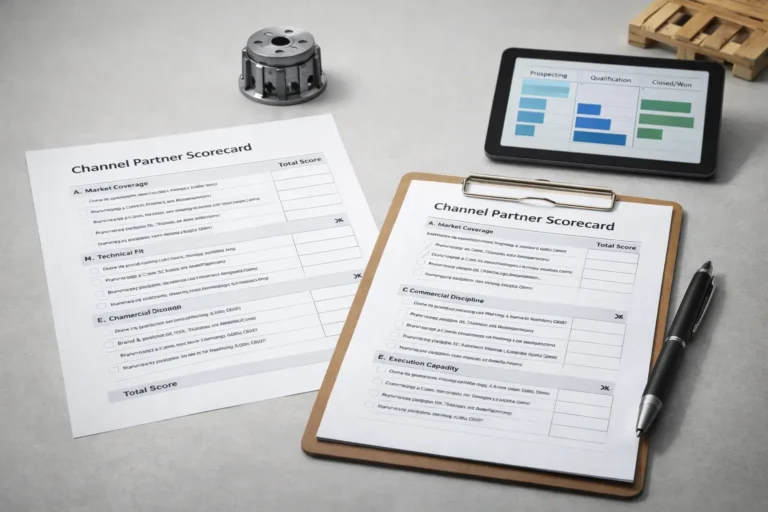
Use a scorecard for any agent/distributor/integrator:
- coverage
- technical fit
- commercial discipline
- positioning
- execution capacity
Days 31–90: Pilot with weekly pipeline discipline
Require a weekly pipeline note:
- top opportunities
- status
- next action + date
- blocking issue
Add one demand-gen action (webinar/email/outreach sequence).
At day 90: scale, replace, or re-scope based on execution evidence.
Export promotion resources can accelerate introductions—but international sales becomes real only when cadence and pipeline discipline exist.
7) Common mistakes (and how to avoid them)
- Mistake: market selection without application clarity
Fix: start from top use-cases and spec drivers - Mistake: partner selection based on “coverage claims”
Fix: scorecards + pilots before exclusivity - Mistake: no separation between inside/outside sales
Fix: inside drives cadence, outside drives depth + closing - Mistake: export promotion used as a substitute for sales
Fix: use promotion for access; win with process
Call to action
REVROK™ documents practical playbooks for international sales, route-to-market design, and channel execution for industrial manufacturers and engineered components. Explore the Export News library and apply the frameworks to your product lines.
Also Read:
- Export News Hub
- Channel Partner Scorecard
- New Sales Agent & Distributor Candidates
- Wanted: Agents & Distributors
FAQs
What is export promotion for industrial manufacturers?
Export promotion refers to programs and resources that help companies enter foreign markets—market intelligence, introductions, missions/events, and guidance. It supports sales execution but doesn’t replace it.
What does an export promotion council do?
An export promotion council typically supports export growth for a sector or category (including “capital goods”). It can provide access and structure—manufacturers still need a route-to-market and measurable pipeline discipline.
What does an international sales representative do in B2B manufacturing?
An international sales representative builds cross-border pipeline by mapping applications and buyers, coordinating partners, managing quoting cadence, and maintaining next-step discipline across long sales cycles.
What’s the difference between an overseas and foreign sales representative?
Often nothing—different labels for similar roles. Both focus on selling outside the home market and coordinating the commercial and operational steps required to close international deals.
How should manufacturers structure inside and outside sales internationally?
Inside sales (international sales development) drives prospecting, qualification, and cadence. Outside sales drives technical depth, relationship building, and closing—often alongside channel partners.
Should engineered components be sold via agents, distributors, or integrators?
It depends on how you win. Agents help early learning and control. Distributors help when lead time/availability and service matter. Integrators are strongest when projects and engineering drive the purchase.
Also on International Sales Development: International sales; Industrial components; Export promotion; Export promotion council; Global sales representative; International sales representative; Overseas sales representative; Foreign sales representative; Inside and outside sales; International sales development; International sales & marketing; Foreign trade sales; Route-to-market; Channel partners; Capital goods exports